

Honor Athletics Training Guide
How to Keep Training When You Travel
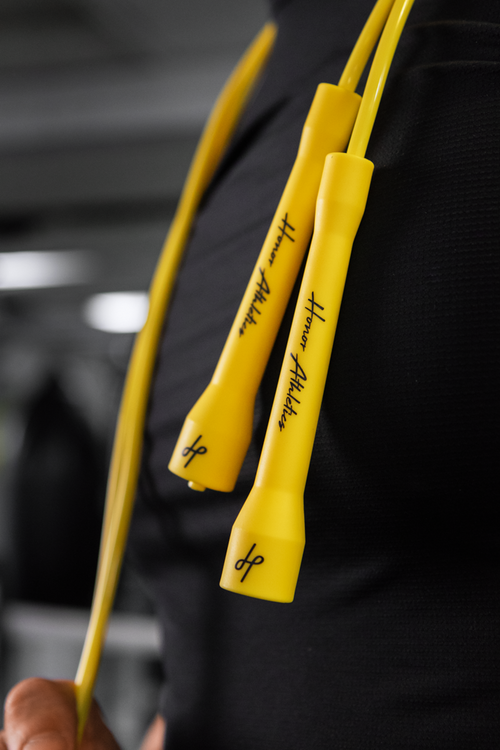
A rope weighs less than a phone charger and turns any hotel room into a conditioning session. Here is how to pack it, where to actually jump, and a 20-minute workout that fits between check-in and dinner.
Travel breaks training routines because the gym disappears, not because motivation does. A rope solves the equipment problem in about 200 grams of luggage. What it does not solve on its own is the room you land in — low ceilings, tile floors, and someone sleeping on the other side of the wall.

Same session, different postcode. The rope travels; the routine does not have to stop.
What to Pack
A travel kit is a packing decision, not a shopping list. Everything below fits in a corner of a carry-on and clears security without a conversation.
One Rope, Coiled
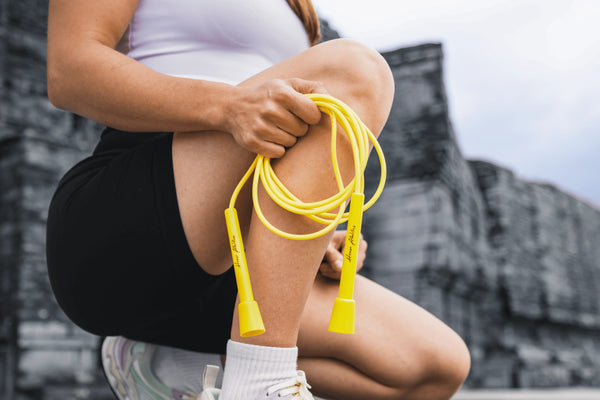
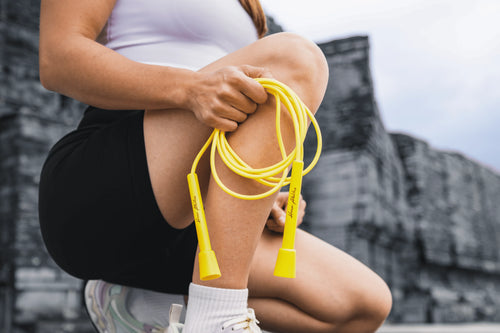
Coil in loops the width of your hand and secure it. A rope stuffed loose into a bag develops permanent kinks that ruin its rotation.
A Small Pouch
Handles scuff screens and lenses. A dedicated pouch also means you grab the rope instead of hunting for it under folded shirts.
A Spare Cable
Cables are the part that fails and the part you cannot replace abroad. One spare weighs almost nothing.
Flat Training Shoes
Whatever you already packed for walking is usually fine, as long as the sole is not tall and soft.
The Adjustment Tool
If your rope needs a screwdriver or key to set the length, it lives with the rope. Not in a drawer at home.
Nothing Else
Resist packing bands, weights and a mat as well. The kit you actually use is the one that takes no thought.
Reading the Room
Spend sixty seconds assessing before your first rep. Three things decide whether you train in the room, in the corridor, or outside.
Ceiling height. Stand with your arms overhead and add a hand's width. If you cannot clear that, the rope will clip the ceiling or a light fitting on every rotation. Floor. Carpet over concrete is the best case in most hotels. Bare tile and polished stone are hard on your joints and hard on the cable. Space. You need roughly your own height in width — push the coffee table aside rather than trying to jump around it.
The 20-Minute Session
Built for a small space and a stiff body after a flight. Keep the jumps low and the rotations tight.
- 0:00 – 3:00 Loosen up. Ankle circles, calf raises, shoulder rolls and thirty seconds of marching in place. Long travel days shorten calves and hip flexors more than most people expect.
- 3:00 – 5:00 Easy basic bounce. Two minutes at a conversational pace. This is your check that the length is right and the ceiling is clear.
- 5:00 – 13:00 Eight rounds, 40 on / 20 off. Alternate a hard round with a steady one. Hard rounds: fast basic bounce or boxer skip. Steady rounds: relaxed pace, breathing through the nose.
- 13:00 – 17:00 Footwork block. Thirty seconds each of side-to-side, front-to-back, single-leg left, single-leg right. Repeat twice. Low impact, high coordination demand, minimal noise.
- 17:00 – 20:00 Cool down. One minute of very slow skipping, then calf and hip flexor stretches. Do not skip this on a travel day — it is the part that decides how you feel tomorrow.
Keeping It Quiet
Hotel floors carry impact to the room below better than almost any surface in a home. Three habits cut most of the noise: land on the balls of your feet with soft knees, keep your jump under two centimetres, and pick a spot near a load-bearing wall rather than the middle of the floor, where floors flex most.
Train during the day rather than late at night, and if the room has a rug, use it. On a longer trip or a stay in an apartment, a proper training surface is the single biggest improvement — for the noise, for your joints, and for the cable, which wears fast against tile and stone.


Travel-Friendly Gear
One rope covers most trips. Which one depends on whether you are chasing pace or space.
 1
1
Travel Bag
Keeps the rope coiled, the handles from scuffing everything, and the whole kit findable in a packed carry-on.
Explore the Travel Bag 2
2
Speed Rope
The lightest thing you can pack that still delivers a real conditioning session. Adjustable, so one rope suits any room.
Explore the Speed Rope 3
3
Pro Boxing Rope
Slower, heavier turnover that suits footwork rounds and tight spaces where you do not want maximum rope speed.
Explore the Boxing RopeCommon Mistakes and Quick Fixes
Pack a Session, Not an Excuse
One rope, one pouch, and any patch of floor. Find the rope that suits how you actually train, then take it with you.
FIND YOUR JUMP ROPEPrev post

What Size Jump Rope Do I Need? Rope Length by Height
Updated on 20 September 2026
Next post

Best Shoes for Jumping Rope: How to Choose a Pair That Protects Your Feet
Updated on 24 August 2026