

How to Extend Your Jump Rope’s Lifespan

25 November 2025
Rope Knots & Storage 🧵
In jump rope, performance matters—but so does equipment lifespan. Proper knotting, coiling, and storage habits dramatically reduce kinking, stiffening, cracking, and early breakage. This guide gives practical, field-tested care and storage techniques for PVC speed ropes, beaded ropes, and weighted ropes.
Why care and storage matter ⚙️
- Friction and kinking fatigue polymer chains, causing speed loss and uneven rhythm.
- UV/heat stiffen PVC and embrittle beads, raising break risk.
- Wrong knots and tight coils create local weak points; micro-cracks spread.
- Dirty bearings/axles increase drag; wrist-turning gets harder, loading the shoulders.

1) Knots: When to use them, how to tie them, what to avoid 🪢
Temporary short-length knot (PVC & beaded)
- When? If your rope isn’t adjustable and you need a temporary fix while you dial in length.
- Where? Place one loose overhand knot on the rope 8–10 cm below the handle.
- Why? Minimizes bending stress, prevents the knot “slug” from slapping the floor, and preserves turn quality.
- Avoid: Double knots, over-tight knots, and midline knots—they disrupt rhythm and invite cracking.
Micro-adjust on beaded ropes
- Don’t constantly move beads. If shortening is needed, take slack near the handle and secure with one loose knot.
- Limit bead remove/replace cycles; frequent manipulation accelerates plastic fatigue.
Weighted ropes
- Do not knot cable/cord-style weighted ropes. Use the in-handle screw/clip mechanism to adjust. Knots damage cable strands.
Golden rule: Knots are temporary. Long-term best practice is tiny in-handle trims or the manufacturer’s adjusters.
2) Coiling: Kill the kinks and “phone-cord” memory 🔁
Proper coil (PVC speed ropes)
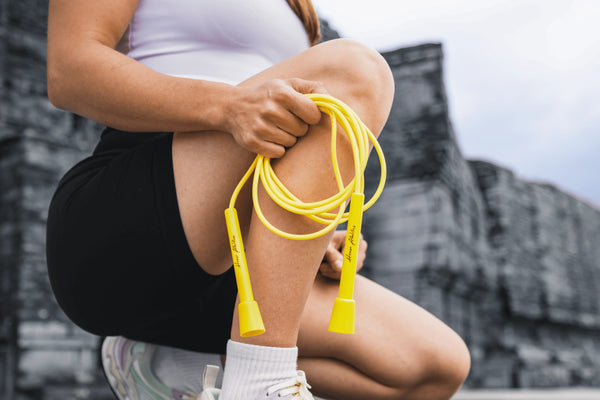
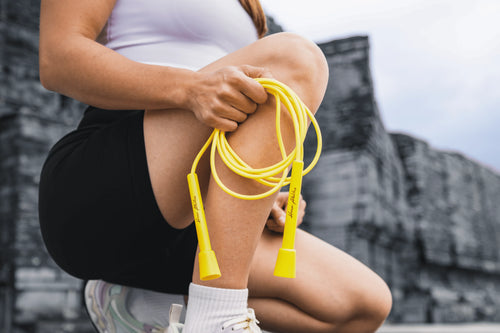
- Large loops: Coil in loose, large loops about arm’s width (≈35–45 cm diameter).
- Figure-eight (∞) coil: Draw a standing ∞ at waist height with both hands, then fold once—prevents single-direction memory.
- No tight bands: Skip tight bands/clamps; point-pressure creates micro-cracks. Use a soft hook-and-loop tie or fabric strap, gently.
Beaded ropes
- Coil loosely so beads don’t compress each other.
- Avoid 90° kinks across bead rows; make long, gentle bends.
Weighted ropes
- Follow the natural lay of the cable/cord. Don’t force a reverse bend.
- After coiling, hang on a hook whenever possible.
3) Storage: Protect from heat, light, and load 🧩
- Hang it (recommended): Wall hooks let the rope hang freely—no coil memory.
- Box/bag: Fine for transport, but don’t leave it in a hot car.
- Avoid sun/heat: Direct sun, radiators, car interiors—PVC stiffens; beads embrittle.
- No weight on top: Dumbbells/books deform rope permanently.
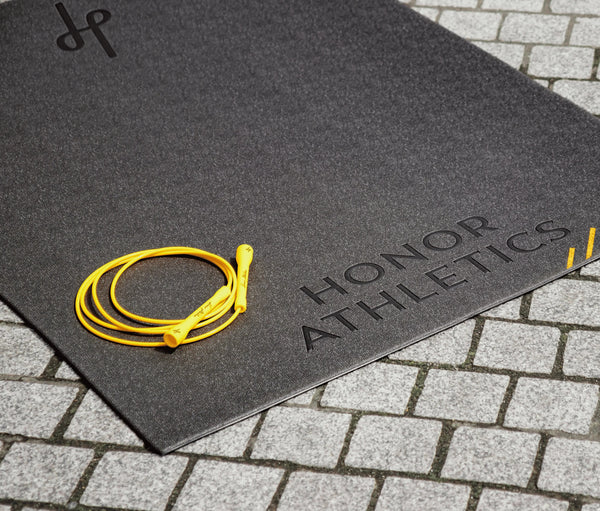
- Floor protection: A jump rope mat reduces abrasion, protects PVC/beads, and cuts noise.

4) Cleaning & light maintenance 🧽
- Dry wipe: After training, use a dry microfiber to remove sweat and dust.
- Damp cloth: For marks, water + mild soap; avoid solvents/alcohol.
- Bearings/axles: Sealed bearings usually don’t need lube; for open mechanisms, apply a tiny drop of light oil and wipe excess.
- Bead check: Replace cracked/split beads; sharp edges scratch rope and floor.
- Handle hardware: Tighten loose screws/clips so length stays consistent.
5) Habits that extend lifespan during use 🦶
- Surface: Concrete/asphalt abrades rope; prefer a mat or wood/PU sport flooring.
- Low jumps: Clear the rope by a few centimeters—less drag, less “whip.”
- Quiet landings: Forefoot/midfoot to reduce whip and shock.
- Avoid edges: Don’t graze walls/columns; sharp corners can cut the sheath.
- Shared rope lengths: Use in-handle adjustments for different users; avoid constant knot/unknot cycles.
6) Common mistakes → quick fixes ✅
-
Mistake: Coiling tight with small diameter.
Fix: Large loops or figure-eight (∞); secure with a soft, loose strap. -
Mistake: Bulky, tight midline knot.
Fix: For temporary fit, one loose knot below the handle—or adjust in-handle. -
Mistake: Leaving rope in a hot car.
Fix: Store cool, shaded, and dry; hang for longer-term storage. -
Mistake: Training daily on rough concrete.
Fix: Use a jump rope mat or gentler surface to prevent abrasion. -
Mistake: Over-lubing bearings.
Fix: If needed, a tiny amount only; wipe excess to avoid dust build-up.
7) 30-Second “Post-Session” Care Routine (Template) ⏱️
- 00:00–00:10 → Quick dry wipe.
- 00:10–00:20 → Large-loop or ∞ coil, secure with a loose soft strap.
- 00:20–00:30 → Hang on a hook or place in bag (cool shade, never a hot car).
Weekly (5–7 days): Check handle screws/clips and scan beads/sheath for wear (1–2 min).
8) Quick notes by rope type 📋
| Rope type | Key care notes |
|---|---|
| PVC speed rope | Most sensitive to UV & heat. Use large-loop/∞ coils, store in shade, train on a mat to extend life. |
| Beaded rope | Beads resist impact but may crack/crush. Coil loosely, hang to store, replace damaged beads promptly. |
| Weighted rope | Don’t knot. Adjust in-handle, avoid reverse bending, and hang whenever possible. |
9) Practical FAQ ❓
| Question | Answer |
|---|---|
| Is a knot a permanent solution? | No. Prefer in-handle adjustment. If you must use a knot, keep it temporary & loose and place it just below the handle. |
| My rope has waves/kinks—what now? | Use the figure-eight (∞) coil and hang for a few days; most memory relaxes. Don’t “soften” with heat/sun. |
| The rope marks my floor—is that normal? | PVC can leave scuffs on hard surfaces. A mat protects both floor and rope and reduces noise. |
10) Simple shopping pointers (kept natural) 🛒
- Jump rope mat: Reduces impact/abrasion; extends PVC/bead life and lowers noise.
- Adjustable speed rope: In-handle trims fit multiple users; less need for knots.
- Spare bead set: Replace only damaged pieces instead of the entire rope.
Bottom line ✅
Your rope’s lifespan depends more on small habits than on brutal workouts: a temporary, handle-adjacent knot (if you must), large/∞ coils, hanging storage, mat-based training, and a 30-second wipe-and-coil. These five habits preserve rhythm, cut avoidable costs, and keep your equipment performing longer.
Prev post

Jump Rope in Winter Mode
Updated on 04 December 2025
Next post

Why Every Boxer Jumps Rope
Updated on 19 November 2025